
Emotional resilience and healing are the keys to bouncing back stronger when life challenges us. It’s not about avoiding stress or pain but learning how to adapt, grow, and find inner strength. By nurturing resilience, we can turn setbacks into opportunities for healing and transformation.
Table of Content
- 1. Introduction to Emotional Resilience
- 2. Emotional Resilience Meaning and Theory
- 3. Why Is Emotional Resilience Important?
- 4. Mindfulness and Emotional Healing
- 5. Maintaining Strong Social Connections
- 6. Fostering a Positive Outlook
- 7. Emotional Healing and Inner Strength
- 8. Capacity to Handle Stress and Setbacks
- 9. Practical Steps to Build Emotional Resilience
- 10. Table: Core Elements of Emotional Resilience
- 11. Conclusion: Bouncing Back Stronger
- FAQs

1. Introduction to Emotional Resilience
Emotional resilience is one of the most valuable skills you can develop in life.
It determines how effectively you deal with stress, overcome challenges, and maintain your well-being even when life feels overwhelming.
Unlike avoiding problems, resilience means facing them head-on while finding healthy ways to adapt.
It’s the ability to recover from painful experiences, setbacks, or crises without losing hope or direction.
Everyone experiences hardship, but resilience allows us to transform struggles into opportunities for personal growth.
When resilience is strong, we don’t merely survive—we thrive, becoming stronger with every challenge we face.
Key Points:
- Resilience is the strength to recover from life’s difficulties.
- Helps you handle stress and crises with calmness.
- Turns challenges into opportunities for growth.
- Builds inner peace and emotional healing.
- Protects your mental and emotional health.
- Enables you to thrive, not just survive.
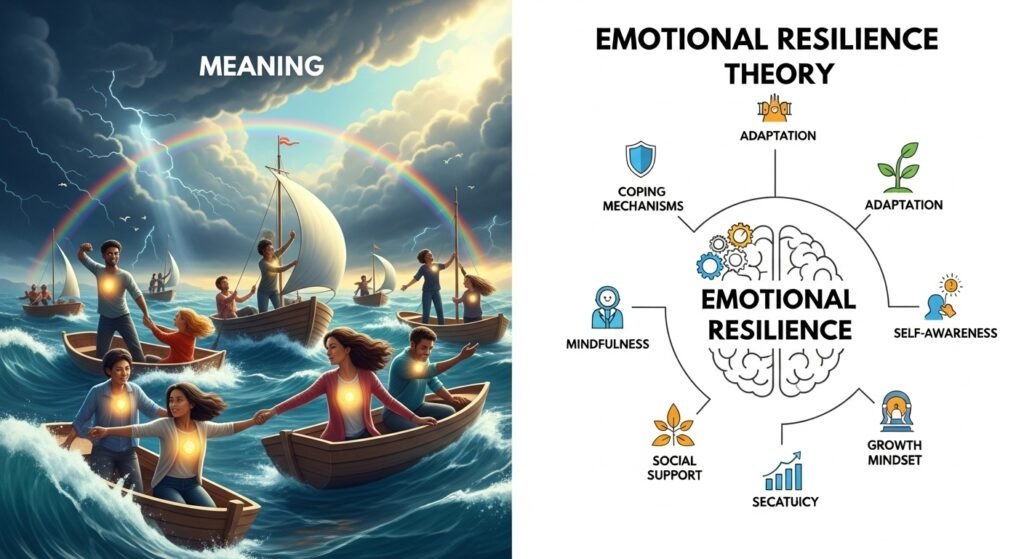
2. Emotional Resilience Meaning and Theory
The emotional resilience meaning is simple: it’s your ability to handle stress, adapt to change, and bounce back from difficulties.
Emotional resilience theory suggests resilience is a combination of personal strengths, positive mindset, and external support systems.
It is not about being emotionless—it is about acknowledging emotions while responding wisely.
Studies show resilient people use coping strategies, mindfulness, and optimism to recover faster.
Emotional resilience is not fixed; it can be cultivated at any stage of life through self-awareness, practice, and support.
This theory highlights resilience as a dynamic skill, constantly shaped by experiences.
Key Points:
- Emotional resilience meaning = ability to adapt and recover.
- Theory: mix of traits, learned skills, and social support.
- Helps manage stress in healthier ways.
- Encourages optimism during adversity.
- Resilience is flexible and can be developed.
- It evolves through life’s experiences.

3. Why Is Emotional Resilience Important?
Emotional resilience is essential because it directly affects your overall quality of life.
Without resilience, even small setbacks can feel overwhelming, leading to stress, burnout, or depression.
Resilience provides emotional strength to face challenges while keeping your mind and body balanced.
It reduces the impact of stress on your physical health, supports stronger relationships, and helps you maintain clarity in decision-making.
In today’s fast-paced world, where uncertainty is constant, resilience is a protective shield against anxiety and fear.
Building emotional resilience means building confidence in yourself, your future, and your ability to overcome difficulties.
Key Points:
- Prevents burnout and mental exhaustion.
- Improves decision-making under pressure.
- Protects mental and physical health.
- Builds self-confidence and inner peace.
- Strengthens relationships and communication.
- Creates stability in uncertain times.

4. Mindfulness and Emotional Healing
Mindfulness plays a central role in developing emotional resilience.
By being present in the moment, mindfulness reduces anxiety and helps regulate overwhelming emotions.
Emotional healing begins when you stop resisting feelings and instead observe them with compassion.
Mindfulness teaches you to pause before reacting, giving you the power to choose healthier responses.
This practice lowers stress, improves focus, and builds resilience by training your brain to stay calm during challenges.
Mindful practices like meditation, journaling, or deep breathing are scientifically proven to increase emotional stability and help you process pain without being consumed by it.
Key Points:
- Mindfulness helps regulate emotions.
- Builds awareness and clarity.
- Creates space between reaction and response.
- Reduces stress and anxiety.
- Supports emotional healing through acceptance.
- Strengthens resilience with calm focus.

5. Maintaining Strong Social Connections
A person’s ability to adapt to crises is greatly influenced by social support.
Strong connections with family, friends, or supportive communities help you feel less isolated during tough times.
These connections provide encouragement, perspective, and practical help. Social bonds remind us we are not alone, making it easier to recover emotionally.
Resilience grows stronger when we share our struggles and receive empathy.
A network of positive, uplifting people also inspires us to keep going when we feel like giving up.
Building relationships is, therefore, not just social—it is emotional self-care.
Key Points:
- Social support reduces feelings of isolation.
- Encouragement helps in overcoming setbacks.
- Builds resilience through shared strength.
- Supportive communities boost confidence.
- Relationships provide practical help and hope.
- Positive bonds inspire healing and growth.

6. Fostering a Positive Outlook
A positive outlook is one of the strongest foundations of emotional resilience.
It doesn’t mean ignoring challenges but facing them with hope and possibility. Positivity reframes setbacks as temporary, not permanent.
When you cultivate optimism, you’re more likely to find solutions instead of feeling stuck.
Scientific studies show positive thinking reduces stress and improves recovery.
Optimism also influences physical health by lowering blood pressure and boosting immunity.
By practicing gratitude and affirmations, you can train your mind to naturally shift toward resilience and healing.
Key Points:
- Optimism helps overcome difficulties.
- Reframes setbacks as opportunities.
- Boosts both emotional and physical health.
- Encourages problem-solving instead of defeat.
- Gratitude practices enhance positivity.
- Creates a resilient, solution-focused mindset.

7. Emotional Healing and Inner Strength
Healing is a vital part of resilience.
Emotional healing allows you to release past pain, forgive, and create space for growth.
It means acknowledging your emotions instead of suppressing them, giving yourself permission to process hurt.
Inner strength develops as you heal—this strength becomes the foundation of resilience.
Healing may involve therapy, meditation, self-reflection, or creative expression.
With time, healing transforms emotional wounds into wisdom.
By focusing on healing, you don’t just recover—you rise stronger and more compassionate.
Key Points:
- Emotional healing transforms pain into growth.
- Inner strength grows as healing progresses.
- Involves acknowledging and processing emotions.
- Can include therapy, journaling, or meditation.
- Forgiveness plays a key role in healing.
- Leads to deeper resilience and empathy.

8. Capacity to Handle Stress and Setbacks
Resilience is the capacity to handle stress and adapt in challenging situations.
It is your ability to keep moving forward, no matter how difficult life becomes. Everyone experiences setbacks, but resilience ensures you rise again with determination.
Stress can weaken your health and emotions if unmanaged, but resilience acts as a protective barrier.
By learning to handle stress positively, you protect your mental clarity and emotional balance.
Stress becomes a teacher rather than a destructive force.
Key Points:
- Resilience = strength to overcome stress.
- Helps maintain mental clarity in crises.
- Stress is managed instead of suppressed.
- Encourages determination to keep going.
- Builds adaptability in uncertain situations.
- Turns stress into a growth opportunity.

9. Practical Steps to Build Emotional Resilience
Developing emotional resilience takes practice, but small daily steps make a huge difference.
Start by practicing mindfulness and gratitude daily. Build strong connections and seek support when needed.
Create healthy routines with exercise, balanced nutrition, and enough sleep.
Embrace flexibility—life rarely goes as planned, but adaptability is key.
Reflect on past challenges and remind yourself of your ability to overcome.
Over time, these practices strengthen resilience and make it easier to handle future stress.
Key Points:
- Practice mindfulness daily.
- Build strong, supportive relationships.
- Develop healthy lifestyle routines.
- Stay flexible and adaptable.
- Reflect on past successes.
- Use gratitude to boost positivity.

10. Table: Core Elements of Emotional Resilience
| Core Element | Description | Benefit |
|---|---|---|
| Mindfulness | Staying present & calm | Reduces stress & improves focus |
| Social Connections | Supportive relationships | Emotional healing & encouragement |
| Positive Outlook | Seeing hope in adversity | Strengthens recovery & problem-solving |
| Stress Management | Healthy coping strategies | Protects mental and physical health |
| Emotional Healing | Releasing pain & forgiving | Builds inner strength & resilience |
| Adaptability | Flexibility in challenges | Boosts ability to thrive in change |
11. Conclusion: Bouncing Back Stronger
Emotional resilience is not about avoiding pain—it’s about building the strength to move through it and emerge stronger. By practicing mindfulness, nurturing social bonds, fostering optimism, and prioritizing emotional healing, anyone can strengthen resilience. The journey requires patience, but each step makes you more capable of handling stress, setbacks, and uncertainty. Resilience is your greatest tool for healing, growth, and transformation. By embracing it, you unlock the power to bounce back stronger every time life tests you.
✅ FAQs
Q1. What is the best definition of emotional resilience?
It is the ability to adapt, recover, and maintain positivity during stressful or challenging times.
Q2. What does emotional resilience theory explain?
It explains resilience as a combination of traits, learned skills, and external support systems.
Q3. Why is emotional resilience important?
It protects mental and physical health, prevents burnout, and builds long-term strength.
Q4. Can mindfulness really build resilience?
Yes, mindfulness helps regulate emotions, reduce stress, and support emotional healing.
Q5. How do strong social connections improve resilience?
They provide encouragement, empathy, and practical help, making recovery easier.
Q6. How can I foster a positive outlook?
Practice gratitude, affirmations, and focus on opportunities rather than obstacles.
Q7. What role does emotional healing play in resilience?
Healing releases past pain and creates space for inner strength and wisdom.
Q8. How do I improve my capacity to handle stress?
Through healthy coping strategies, relaxation techniques, and adaptability.
Q9. What are simple daily steps to build resilience?
Mindfulness, journaling, exercise, strong relationships, and gratitude practices.
Q10. Is emotional resilience something you’re born with?
No, it can always be developed and strengthened through practice and experience.
After six years of relationship, my partner and I got separated. Despite my efforts, nothing worked—until I sought spiritual guidance from priest Sims. His prayers and support led to a reconciliation I once thought impossible. We are now happily reunited, and I truly believe in the power of prayer. If you’re facing relationship challenges, don’t give up. WhatsApp Priest Sims 1-564-222-6643