
Communication shapes every relationship in your life. Whether you’re navigating a heated discussion with your partner or delivering feedback to a team member, how you communicate determines the outcome.
Poor communication destroys relationships, creates workplace tension, and leaves you feeling misunderstood.
But here’s the good news: healthy communication skills can be learned.
This guide reveals proven strategies to transform how you connect with others.
You’ll discover practical techniques for building trust, resolving conflicts, and creating deeper bonds both personally and professionally.
Ready to become a more effective communicator? Let’s dive in.
Table of Contents
- What Are Healthy Communication Skills?
- The Science Behind Effective Communication
- Core Elements of Healthy Communication
- Active Listening: The Foundation of Connection
- Healthy Communication Skills in Relationships
- Healthy Communication Skills in the Workplace
- Nonverbal Communication Mastery
- Managing Difficult Conversations
- Digital Communication Best Practices
- Building Emotional Intelligence for Better Communication
- Common Communication Barriers and Solutions
- Healthy Communication Skills Examples in Action
- Frequently Asked Questions

What Are Healthy Communication Skills?
Healthy communication involves expressing yourself clearly, listening actively, and responding thoughtfully.
It’s not about avoiding conflict—it’s about navigating disagreements constructively.
These skills create an environment where everyone feels heard, valued, and understood.
At its core, healthy communication requires three key components: clarity, empathy, and respect.
You communicate clearly when your message is direct and specific.
You show empathy by considering the other person’s perspective.
You demonstrate respect by treating others with dignity, even during disagreements.
Research from the University of Pennsylvania shows that couples who practice healthy communication report 67% higher relationship satisfaction.
In workplace settings, teams with strong communication skills are 25% more productive and experience 50% fewer conflicts.

The Science Behind Effective Communication
Your brain processes communication through multiple channels simultaneously.
The prefrontal cortex handles language and reasoning, while the amygdala manages emotional responses.
When stress levels rise during difficult conversations, the amygdala can hijack rational thinking—a phenomenon psychologists call “amygdala hijack.”
Understanding this biological process helps you communicate more effectively.
When you feel your emotions escalating, pause and take three deep breaths.
This simple technique activates your parasympathetic nervous system, returning control to your prefrontal cortex.
Neuroscientist Dr. Daniel Siegel’s research reveals that mindful communication creates new neural pathways.
The more you practice healthy communication skills, the more automatic they become.
Your brain literally rewires itself to communicate better.

Core Elements of Healthy Communication
Authenticity
Speak your truth without masks or pretense. Authentic communication builds trust because people sense when you’re being genuine. This doesn’t mean sharing every thought—it means being honest about what you choose to share.
Clarity
Vague messages create confusion and frustration. Instead of saying “We need to talk,” try “I’d like to discuss our weekend plans—are you free for 10 minutes?” Specific language eliminates guesswork and shows respect for the other person’s time.
Empathy
Put yourself in the other person’s shoes before responding. Ask yourself: “How might they be feeling right now?” This mental shift transforms defensive reactions into compassionate responses.
Timing
Even perfect words can fail if delivered at the wrong moment. Avoid serious conversations when either person is hungry, tired, or stressed. Create space for meaningful dialogue by choosing optimal timing.

Active Listening: The Foundation of Connection
Active listening goes beyond hearing words—it involves understanding meaning, emotion, and intent. Most people listen to respond rather than to understand. This common mistake breaks connection and escalates conflicts.
True active listening requires your full attention. Put down your phone, make eye contact, and resist the urge to formulate your response while the other person speaks. Instead, focus entirely on their message.
Use reflective listening to confirm understanding: “It sounds like you’re feeling overwhelmed by your workload. Is that accurate?” This technique shows you’re genuinely trying to understand their perspective.
The 70-30 rule proves helpful in most conversations. Listen 70% of the time and speak 30%. This ratio naturally creates space for deeper understanding and stronger connections.

Healthy Communication Skills in Relationships
Healthy communication in relationships requires effort, patience, and intentionality. It is essential to express your feelings and needs openly while also being receptive to your partner’s concerns. Practice empathy by putting yourself in their shoes and validating their emotions, even if you don’t fully agree.
Personal relationships thrive on emotional intimacy and mutual understanding. Healthy communication skills in relationships require vulnerability, patience, and consistent practice. Here’s how to strengthen your most important connections:
Express Needs Directly
Replace assumptions with clear requests. Instead of expecting your partner to read your mind, say: “I need 30 minutes to decompress after work before we discuss our day.” Direct communication eliminates guesswork and prevents resentment.
Use “I” Statements
“You” statements trigger defensiveness.
“I” statements express your feelings without blame. Compare these approaches:
- “You never help with housework” (accusatory)
- “I feel overwhelmed managing all the household tasks and would appreciate your help” (constructive)
Practice Emotional Validation
Validation doesn’t require agreement—it acknowledges the other person’s feelings as legitimate.
Say: “I can see why that situation would be frustrating” before offering solutions or different perspectives.
Create Communication Rituals
Establish regular check-ins to maintain connection.
Weekly relationship meetings, daily gratitude sharing, or bedtime conversations create consistent opportunities for meaningful dialogue.

Healthy Communication Skills in the Workplace
Healthy communication in the workplace fosters collaboration, reduces misunderstandings, and promotes a positive environment.
Clear and respectful exchanges help ensure that team members feel heard and valued.
Additionally, active listening and open feedback contribute to building trust and improving overall productivity.
Professional environments demand a different communication approach than personal relationships.
Workplace communication must balance relationship-building with task completion, diplomacy with directness.
Provide Constructive Feedback
Effective feedback focuses on specific behaviors rather than personality traits. Use the SBI model:
- Situation: “During yesterday’s client meeting…”
- Behavior: “…when you interrupted the client three times…”
- Impact: “…they seemed frustrated and cut the meeting short.”
This approach addresses the issue without attacking the person’s character.
Navigate Hierarchical Dynamics
Navigating hierarchical dynamics requires a balance of respect and assertiveness.
Acknowledge the authority of those in higher positions while ensuring your ideas and contributions are still clearly communicated.
Building rapport across levels fosters mutual understanding and supports cohesive teamwork.
Maintaining professional boundaries while exhibiting confidence can help bridge gaps within the structure.
Communication styles must adapt to organizational structure.
When speaking with supervisors, lead with key points and support with details.
With subordinates, provide context and reasoning behind decisions.
Peer communication benefits from collaborative language and shared problem-solving.
Master Virtual Communication
Effective virtual communication requires clarity, attentiveness, and the right tools. Start by ensuring your message is concise and tailored to the audience, avoiding unnecessary jargon. Utilize video and audio tools that enhance engagement and maintain professionalism during interactions. Active listening and timely responses are key to building trust and fostering productive virtual relationships.
Remote work requires intentional communication strategies. Overcommunicate rather than under communicate in digital formats. Use video calls for complex discussions, emails for documentation, and instant messaging for quick questions.
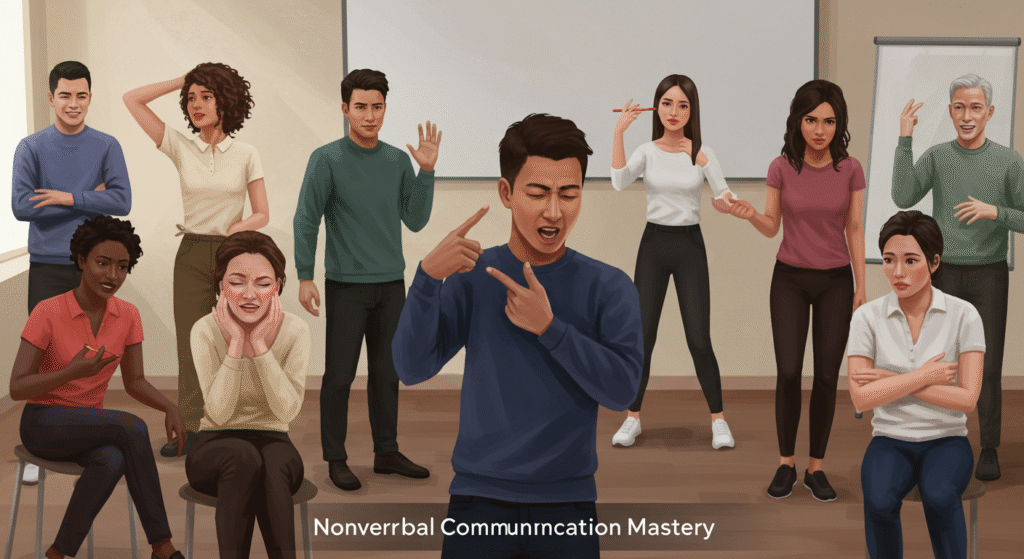
Nonverbal Communication Mastery
Nonverbal communication plays a critical role in virtual interactions, often conveying more than words can express.
Maintaining appropriate eye contact through the camera, using facial expressions to convey empathy, and adopting an open posture can greatly impact how messages are received.
Gestures, tone of voice, and even the pace of speech can all influence the clarity and effectiveness of communication.
Being mindful of these nonverbal cues helps in creating a positive and collaborative environment in remote settings.
Research indicates that 55% of communication happens through body language, 38% through tone of voice, and only 7% through actual words.
Your nonverbal signals can support or sabotage your verbal message.
Body Language Awareness
Open postures signal receptivity and confidence.
Crossed arms, fidgeting, or avoiding eye contact can undermine your words.
Practice power posing before important conversations to boost confidence and project authority.
Tone Management
Your voice carries emotional information that words alone cannot convey.
Record yourself during practice conversations to identify tone patterns.
A calm, steady voice projects confidence and reduces tension.
Facial Expressions
Your face reveals emotions before you speak.
Practice neutral expressions during difficult conversations to avoid inadvertently escalating situations.
Micro-expressions leak true feelings, so align your internal state with your desired message.

Managing Difficult Conversations
Prepare for challenging interactions by clarifying your objectives and anticipating potential reactions.
Active listening plays a crucial role in defusing tension and fostering understanding.
Staying empathetic and composed ensures the conversation remains productive and respectful.
Difficult conversations are inevitable in both personal and professional relationships.
The key lies in preparation, emotional regulation, and strategic approach.
Preparation Strategies
Before entering challenging discussions:
- Clarify your objectives
- Anticipate potential reactions
- Choose neutral location and timing
- Practice key phrases
- Prepare for multiple outcomes
De-escalation Techniques
When tensions rise, use these proven methods:
- Lower your voice (others typically mirror your volume)
- Acknowledge emotions: “I can see this is important to you”
- Take breaks when needed: “Let’s pause for five minutes”
- Find common ground: “We both want this project to succeed”
Problem-Solving Focus
Shift from blame to solution-finding.
Ask: “How can we move forward?” rather than “Who’s responsible for this mess?”
This reframe transforms adversarial conversations into collaborative problem-solving sessions.

Digital Communication Best Practices
When communicating digitally, clarity and tone are crucial to avoid misunderstandings.
Be concise, but ensure your message provides all necessary context to eliminate confusion.
Use a polite and professional tone, even in challenging situations, as written words lack the nuances of verbal communication.
Email, text messages, and video calls require adapted communication strategies.
Written communication lacks nonverbal context, making clarity and tone even more critical.
Email Excellence
Structure professional emails using the BRIEF method:
- Brief: Keep messages concise
- Relevant: Include only necessary information
- Informative: Provide clear context
- Engaging: Use active voice and specific language
- Friendly: Maintain professional warmth
Text Message Etiquette
Personal text communications should balance efficiency with relationship maintenance.
Respond within reasonable timeframes, use complete sentences for important matters, and clarify tone when necessary with emojis or explicit statements.
Video Call Mastery
Virtual meetings demand heightened communication skills.
Speak slightly slower than in-person conversations, use gestures deliberately, and create engagement through questions and interactive elements.

Building Emotional Intelligence for Better Communication
Developing emotional intelligence is crucial for effective communication.
It involves self-awareness, empathy, and the ability to manage emotions in both yourself and others.
By understanding your own emotional triggers and responding to others with compassion, you can foster trust and reduce misunderstandings.
These skills also enable you to adapt your communication style to different contexts, ensuring greater connection and collaboration.
Emotional intelligence (EQ) directly impacts communication effectiveness.
High-EQ individuals recognize their emotional states, manage reactions, and respond to others’ emotions appropriately.
Self-Awareness Development
Monitor your emotional triggers during conversations.
Notice physical sensations like tension, rapid heartbeat, or shallow breathing.
These signals indicate rising stress levels that can impair communication quality.
Emotional Regulation Techniques
Practice the STOP method when emotions escalate:
- Stop what you’re doing
- Take a deep breath
- Observe your feelings and thoughts
- Proceed with intentional response
This pause creates space between trigger and response, allowing for more thoughtful communication choices.
Social Awareness Skills
Read emotional cues in others through:
- Facial expressions and micro-expressions
- Body language changes
- Vocal tone variations
- Energy level shifts
Adjust your communication approach based on these observations to maintain connection and effectiveness.

Common Communication Barriers and Solutions
Understanding common obstacles helps you navigate communication challenges more effectively. Here are the most frequent barriers and proven solutions:
| Barrier | Description | Solution |
|---|---|---|
| Assumptions | Making conclusions without verification | Ask clarifying questions |
| Emotional Overwhelm | Strong feelings blocking rational thought | Take breaks and regulate emotions |
| Cultural Differences | Varying communication styles and norms | Learn about different cultural approaches |
| Information Overload | Too much information at once | Break complex topics into smaller parts |
| Distractions | External interruptions breaking focus | Create distraction-free environments |
| Past Conflicts | Historical issues affecting current discussions | Address underlying issues directly |
| Language Barriers | Different native languages or vocabulary | Use simple, clear language and confirm understanding |
| Power Imbalances | Hierarchical differences affecting openness | Create psychological safety and encourage input |

Healthy Communication Skills Examples in Action
Effective communication requires a combination of practical strategies and intentional behaviors.
These include active listening, where individuals focus fully on the speaker and provide thoughtful responses, ensuring mutual understanding.
Additionally, maintaining a calm and respectful tone during discussions fosters a positive environment for collaboration.
Nonverbal cues, such as eye contact and open body language, also play a key role in conveying attentiveness and sincerity.
Asking clarifying questions ensures that all parties are aligned and helps avoid misunderstandings.
Finally, showing empathy by considering others’ perspectives builds trust and strengthens relationships within any group or team.
Real-world applications help solidify communication concepts. Here are specific examples across different contexts:
Relationship Example: Weekend Planning Conflict
Ineffective Approach: “You never want to do anything fun. All you do is work.”
Healthy Communication: “I’ve been looking forward to spending quality time together this weekend. I noticed you’ve been working late every night this week. Can we talk about how to balance your work needs with our relationship time?”
Workplace Example: Project Deadline Pressure
Ineffective Approach: “This timeline is impossible. Management doesn’t understand what we’re dealing with.”
Healthy Communication: “I want to ensure we deliver quality work on time. Based on current resources, I see some challenges meeting this deadline. Can we discuss priorities and potential solutions?”
Conflict Resolution Example: Household Responsibilities
Ineffective Approach: “I do everything around here while you just relax.”
Healthy Communication: “I’ve been feeling overwhelmed with household tasks lately. I’d like to discuss how we can share these responsibilities more evenly. What are your thoughts?”
These examples demonstrate how healthy communication transforms potentially destructive interactions into constructive dialogue.
Frequently Asked Questions
- How do I communicate with someone who won’t listen?
Start by examining your own communication approach. Are you speaking in a way that invites listening? Try these strategies:
- Begin with something positive
- Ask for their perspective first
- Use reflective listening to show understanding
- Address their concerns before presenting your viewpoint
- Choose optimal timing when they’re receptive
- What’s the difference between being assertive and aggressive?
Assertive communication respects both your needs and others’ needs. It’s direct but kind. Aggressive communication prioritizes your needs while dismissing others. Assertiveness uses “I” statements and collaborative language, while aggression uses blame and demands.
- How can I stay calm during heated arguments?
Practice emotional regulation techniques:
- Take slow, deep breaths
- Count to ten before responding
- Use the phrase “Help me understand…”
- Focus on the issue, not the person
- Take breaks when emotions escalate
- Remember your relationship goals
- Should I always avoid conflict?
No. Healthy relationships require navigating disagreements constructively. Avoiding conflict often leads to resentment and unresolved issues. Instead, learn to approach conflict as an opportunity for growth and deeper understanding.
- How do I know if I’m communicating effectively?
Monitor these indicators:
- Others seem to understand your messages
- You feel heard and understood
- Conflicts resolve rather than escalate
- Relationships strengthen over time
- You achieve desired outcomes from conversations
- People seek your input and advice
- What’s the best way to give feedback?
Use the SBI model (Situation-Behavior-Impact) and follow these guidelines:
- Be specific rather than general
- Focus on behaviors, not personality
- Provide examples
- Suggest alternative approaches
- Ask for their perspective
- Follow up to ensure understanding
- How do I communicate with someone from a different cultural background?
Research their cultural communication norms, but avoid stereotypes. Ask questions about preferences, speak clearly and avoid idioms, be patient with language barriers, observe their communication style, and adapt accordingly while maintaining respect.
- Can communication skills really be learned?
Absolutely. Communication is a skill set that improves with practice and awareness. Like any skill, consistent practice leads to improvement. Many people see significant progress within 30 days of focused practice.
Final Thought
Healthy communication transforms relationships and opens opportunities.
Whether you’re strengthening personal bonds or advancing professionally, these skills serve as your foundation for success.
Start with one technique from this guide and practice it consistently.
Small improvements in how you communicate create massive improvements in how you connect with others.
The journey toward better communication never ends, but every step forward brings richer relationships and deeper understanding.
Your future self will thank you for investing in these essential life skills today.